38. Incentives, Tax Credits & Financing
⚠️ TIME-SENSITIVE: verify before use. Mechanics are evergreen; the current values and deadlines reflect US policy as of mid-2026 and change.
Learning objectives
- Explain how incentives mechanically work (evergreen).
- State the current US federal landscape and its deadlines (volatile).
- Distinguish the financing structures and who claims the credit.
38.1 How incentives work (evergreen mechanics)
- Investment Tax Credit (ITC): a credit worth a percentage of system cost, applied against taxes owed by whoever owns the system.
- Accelerated depreciation (MACRS): lets a business owner deduct the system’s value over an accelerated schedule, a major commercial benefit that stacks with the ITC.
- State/utility incentives: rebates, performance payments, and SRECs (Solar Renewable Energy Certificates, sold per MWh in some states).
- Net metering / net billing: the value of exported energy (Ch 10), often the largest lifetime “incentive” of all.
38.2 The current US federal landscape (mid-2026: verify)
US federal policy shifted sharply with the One Big Beautiful Bill Act (OBBBA), signed July 4, 2025:
- Residential (Section 25D): ended. The 30% homeowner credit terminated for systems installed after December 31, 2025, with no phase-out. In 2026, a homeowner who buys with cash or a loan gets $0 federal credit (systems installed in 2025 still claim 30%).
- The remaining homeowner path: third-party ownership. With leases, PPAs, and prepaid products, the business that owns the system claims the commercial 48E credit and passes the benefit through lower payments. This path is available through end of 2027.
- Commercial / utility (Section 48E): available but closing. The 30% ITC remains for projects that begin construction by July 4, 2026 or are placed in service by December 31, 2027, with a construction safe-harbor window thereafter. New FEOC (Foreign Entity of Concern) sourcing rules apply to 2026+ construction. Combined with MACRS, businesses can recover close to half the system cost. Direct Pay lets tax-exempt entities take the credit as a cash refund.
- Storage has a longer runway. Standalone/leased battery storage isn’t subject to solar’s accelerated phase-out (its step-down begins later), which strategically favors storage and VPP projects.
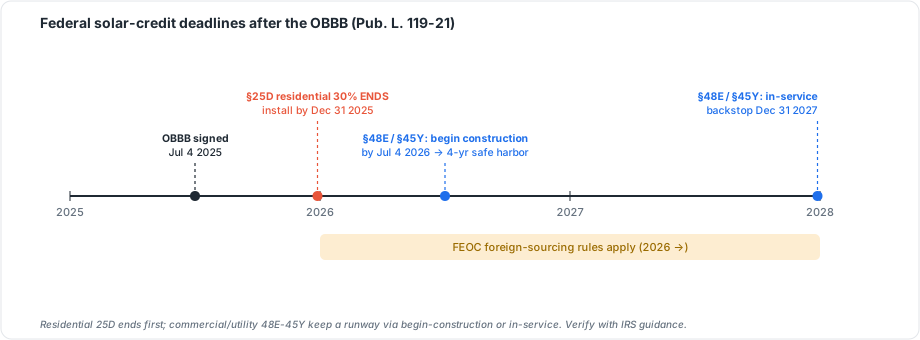 Figure 38.1: Federal solar-credit deadlines after the OBBB (Pub. L. 119-21). Fast-moving law; verify against IRS guidance. Original figure.
⚠️ These dates and values are the single most perishable content in this primer. Always confirm current federal, state, and utility policy at the time of a project. Treat the above as the mid-2026 snapshot, not standing fact.
38.3 Financing structures
- Cash: customer owns; best lifetime return; claims any owner credit.
- Loan: customer owns and finances; payment vs savings determines value.
- Lease: third party owns; customer pays fixed rent; the owner claims the credit (the key post-OBBBA residential path).
- PPA (Power Purchase Agreement): third party owns; customer pays per kWh produced; owner claims the credit.
Who owns the system determines who claims the tax benefit. That is the central fact of post-2025 residential financing.
38.4 Financing structures compared (mid-2026: ⚠️ verify)
| Structure | Who owns | Who claims the credit | Customer’s position |
|---|---|---|---|
| Cash | Customer | Customer (but residential 25D ended for 2026 cash/loan) | Best lifetime return; full savings |
| Loan | Customer | Customer (same 25D limitation) | Owns system; payment vs savings |
| Lease | Third party | The owner (business) via 48E | Fixed monthly rent; benefit passed through |
| PPA | Third party | The owner (business) via 48E | Pays per kWh produced |
⚠️ Time-sensitive: post-OBBBA, a 2026 residential cash/loan buyer gets $0 federal credit. The federal benefit now reaches homeowners only through third-party ownership (lease/PPA), where the business claims 48E (through 2027). Commercial owners stack 48E + MACRS. Confirm current federal/state/utility policy at the time of every project. These values and deadlines change.
Chapter 38 summary
Incentives mechanically reward the owner: the ITC (% of cost), MACRS depreciation (business), state/utility programs, and net metering. As of mid-2026, the residential 25D credit has ended (no phase-out). Homeowners reach a federal credit only via TPO leases/PPAs under 48E (through 2027), while commercial 48E requires construction beginning by July 4, 2026 or service by end-2027, with storage on a longer runway. Re-verify all of this per project.
- ITC (Investment Tax Credit): a dollar-for-dollar credit against taxes owed, based on a percentage of system cost; claimed by the system owner.
- MACRS: IRS accelerated depreciation schedule for business-owned solar assets; stacks with the ITC.
- Section 25D: the residential homeowner solar credit; terminated for systems installed after Dec 31, 2025.
- Section 48E: the commercial/utility ITC; requires begin-construction by Jul 4, 2026 or in-service by Dec 31, 2027.
- FEOC: Foreign Entity of Concern; FEOC-sourced components disqualify a project from 48E starting in 2026.
- Direct Pay: IRS provision letting tax-exempt entities receive the ITC as a cash refund.
- TPO (Third-Party Ownership): lease or PPA model where a business owns the system and claims the credit.
- PPA (Power Purchase Agreement): customer pays per kWh produced; third-party owner claims the tax credit.
- SREC: Solar Renewable Energy Certificate; 1 MWh = 1 SREC, tradeable in some state markets.
- MACRS + 48E stacking: combining accelerated depreciation with the commercial ITC; allows businesses to recover close to half of system cost.
Full definitions: Appendix A (glossary).
Practice Problems: Chapter 38
- In a lease or PPA, who claims the federal tax credit: the homeowner or the system owner?
- As of mid-2026, what federal credit does a homeowner who buys with cash receive?
- Which two federal benefits can a commercial owner stack?
- Why has third-party ownership become the main residential path to a federal benefit?
- What’s the single most important caveat to attach to any statement about tax-credit values or deadlines?
Solutions: Chapter 38
- The system owner (the third-party business), via the 48E commercial credit.
- $0. The residential 25D credit ended for systems installed after Dec 31, 2025.
- The 48E ITC and MACRS accelerated depreciation.
- Because direct ownership no longer earns a residential federal credit, the credit only flows through the business owner in a lease/PPA, who passes the benefit through lower payments.
- Verify current policy per project. Federal/state/utility values and deadlines are volatile and dated to mid-2026 here.