17. Battery Bank Sizing
Learning objectives
- Size storage to its purpose (backup vs autonomy vs arbitrage).
- Separate the energy (kWh) and power (kW) sizing questions.
- Apply usable capacity, DoD, and round-trip efficiency correctly.
17.1 Size to the job
Storage sizing depends entirely on why it exists (Chapter 9.1):
- Backup: size to critical-load energy × desired backup duration.
- Off-grid autonomy: size to daily load × days of autonomy (Chapter 11.2).
- Self-consumption / arbitrage: size to the daily surplus or peak-window energy you want to shift.
17.2 Energy sizing (kWh)
Account for what you can actually use:
Required nameplate kWh = (Critical load kWh × Days/Duration) ÷ (DoD × Round-trip efficiency)
Usable capacity = nameplate × DoD (LFP often 90–100%); round-trip efficiency ~0.90.
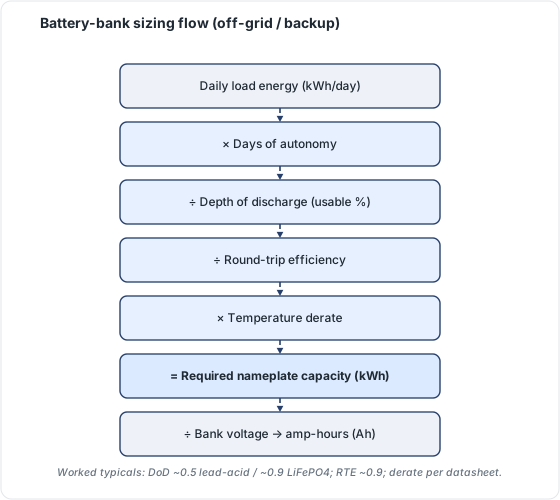 Figure 17.1: Battery-bank sizing flow (off-grid / backup). Original figure.
Example 17.A (backup): Critical loads draw 1.2 kW averaged over a desired 12-hour outage = 14.4 kWh needed. With LFP DoD 0.95 and RTE 0.90: Nameplate = 14.4 ÷ (0.95 × 0.90) = 14.4 ÷ 0.855 = 16.8 kWh → specify ~2 × 10 kWh units.
Example 17.B (off-grid): Daily load 6 kWh × 3 days autonomy = 18 kWh ÷ (0.95 × 0.90) = 21 kWh nameplate minimum, before cold-temperature and aging margins.
17.3 Power sizing (kW)
Energy isn’t enough. The battery and inverter must deliver the continuous power the critical loads draw and the surge that motors (well pumps, A/C, fridges) demand at startup. Check both the continuous kW and surge kW ratings against the load list. A battery with ample kWh but insufficient kW can’t start the pump it was bought to back up.
C-rate (Chapter 9.3) bounds this.
17.4 Worked example: sizing both energy and power
A homeowner wants backup for: fridge (150 W continuous, 900 W surge), well pump (800 W continuous, 2,400 W surge), lights + electronics (300 W), for an 8-hour evening outage. Battery: LFP, DoD 0.95, RTE 0.90.
Energy: continuous load ≈ 150 + 800 (intermittent, assume 25% duty = 200 W avg) + 300 = ~650 W average × 8 h = 5.2 kWh needed. Nameplate = 5.2 ÷ (0.95 × 0.90) = 6.1 kWh → a single ~10 kWh unit covers it with margin.
Power: the inverter must serve the continuous peak (fridge + pump + lights running together = 150 + 800 + 300 = 1,250 W) and the surge when the pump starts (its 2,400 W surge + others ≈ ~2,850 W instantaneous). ⚠️ A 10 kWh battery with only a 3 kW continuous / 3.8 kW surge inverter is borderline on the pump start. Confirm surge headroom, or the battery with ample kWh still won’t start the pump. Sizing energy without checking power is the classic backup-design failure.
Chapter 17 summary
Size storage to its purpose. For energy: nameplate kWh = (load × duration) ÷ (DoD × RTE). For power: confirm continuous and surge kW cover the critical loads, not just total energy. Off-grid adds days-of-autonomy and worst-case margins.
- DoD (Depth of Discharge): the fraction of nameplate capacity that can be drawn before recharging; LFP typically 90–100%.
- RTE (Round-Trip Efficiency): energy-out ÷ energy-in for a full charge/discharge cycle; ~0.90 for LFP.
- LFP (Lithium Iron Phosphate): the dominant solar-storage lithium chemistry; high DoD, long cycle life, good thermal stability.
- C-rate: discharge rate relative to capacity; bounds the maximum continuous and surge power a battery can deliver.
- Nameplate capacity: the total kWh rating printed on the battery, before DoD derating.
- Surge kW: peak instantaneous power demand at motor startup, typically 3–6× the running wattage; must be checked against inverter surge rating.
Full definitions: Appendix A (glossary).
Practice Problems: Chapter 17
- Critical loads average 0.9 kW over a desired 10-hour backup. How many kWh of usable energy are needed?
- With LFP DoD 0.92 and RTE 0.90, what nameplate capacity does that require?
- An off-grid cabin uses 5 kWh/day and wants 4 days of autonomy. What nameplate capacity (DoD 0.95, RTE 0.90) is the minimum?
- A 13.5 kWh battery has 95% usable DoD. How many usable kWh is that?
- A battery stores plenty of kWh but its inverter is rated 3 kW continuous. The well pump needs 800 W running but 2,400 W to start. What’s the risk, and what spec must you check?
- Why does off-grid sizing use worst-month solar and a days-of-autonomy margin, while grid-tied backup sizing doesn’t?
Solutions: Chapter 17
- 0.9 kW × 10 h = 9 kWh usable.
- 9 ÷ (0.92 × 0.90) = 9 ÷ 0.828 = 10.9 kWh nameplate.
- 5 × 4 = 20 kWh usable ÷ (0.95 × 0.90) = 20 ÷ 0.855 = 23.4 kWh nameplate minimum.
- 13.5 × 0.95 = 12.8 kWh usable.
- The battery may have energy but the inverter’s surge rating may be too low to start the pump’s 2,400 W inrush; check the continuous and surge kW ratings, not just kWh.
- Off-grid has no grid backstop, so it must survive the darkest month and a run of cloudy days on stored energy alone; grid-tied backup only spans a finite outage, with the grid recharging afterward.