11. Off-Grid Systems
Learning objectives
- Describe off-grid architecture and its added components.
- Explain “days of autonomy” and load discipline as design drivers.
- Compare PWM and MPPT charge controllers.
11.1 Architecture
An off-grid (stand-alone) system has no utility connection and must meet 100% of demand on its own: PV array → charge controller → battery bank → inverter → loads, very often with a backup generator for low-sun stretches. Every watt-hour the loads need must be generated and stored on-site.
11.2 Design drivers
- Days of autonomy: how many cloudy days the battery must carry the loads with no solar input. This sizes the battery bank and dominates cost.
- Load discipline: off-grid design is demand-first and ruthless: efficiency, load scheduling, and sometimes behavioral limits, because oversizing generation/storage to cover careless loads is brutally expensive.
- Worst-month sizing: off-grid arrays are typically sized to the worst solar month (e.g., December at high latitude), not the annual average, so the system never starves. Sizing to an annual average allows the battery to slowly deplete during low-sun months, shortening its life with no grid backstop to recover.
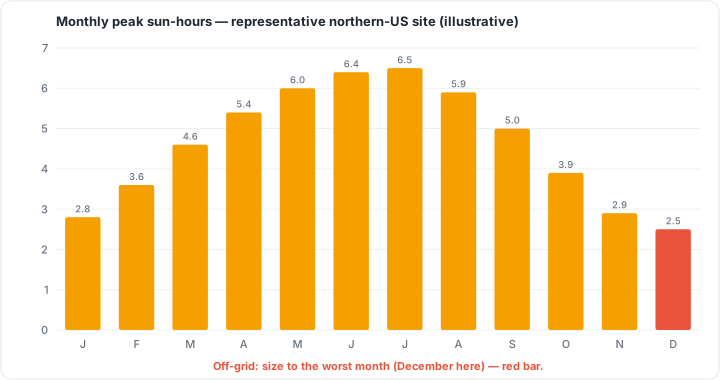 Figure 11.1: Monthly peak sun-hours, representative northern-US site (illustrative). Off-grid systems are sized to the worst month. Original figure.
Worst-month sizing: worked chain. Load 240 Wh/day; January worst-month 2.5 peak-sun-hours. Array minimum: 240 / 2.5 / 0.85 (soiling/aging/wiring) = ~113 W. Battery (5 days autonomy, lead-acid at 20°F derate, 50% DoD): 240 × 1.1 (inverter loss) × 1.59 (cold derate) × 1.2 (round-trip loss) ≈ 504 Wh/day × 5 days = ~2,520 Wh (~210 Ah at 12 V). For a real site, pull worst-month peak-sun-hours from NREL PVWatts; the chain is the same.
11.3 Charge controllers
The controller regulates PV charging of the battery:
- PWM (Pulse-Width Modulation): simpler, cheaper, less efficient. Best when array voltage closely matches battery voltage.
- MPPT (Maximum Power Point Tracking): does the same job an inverter’s MPPT does, harvesting more from the array (especially when array voltage exceeds battery voltage) at higher cost. The standard for serious off-grid systems.
11.4 Tradeoffs
Total energy independence and viability where no grid exists come at the highest cost and complexity per usable kWh, with batteries and generator maintenance as ongoing burdens. Most “resilience” customers are better served by a grid-interactive hybrid (Chapter 12) than a true off-grid build.
11.4 Off-grid one-line
 [ARRAY]──DC──[MPPT charge controller]──[BATTERY BANK]──[inverter]──[AC loads]
                                              │
                                       [generator]──► backup charging on
                                                      cloudy stretches / high demand
   No utility. Sized to WORST month + days of autonomy + strict load discipline.
Chapter 11 summary
Off-grid systems are self-sufficient: array + charge controller + battery bank + inverter (+ generator). Sizing is driven by days of autonomy, worst-month solar, and strict load discipline. Use MPPT controllers for efficiency. The payoff is independence; the cost is complexity and expense.
- Off-grid (stand-alone): a PV system with no utility connection; must generate and store 100% of its own energy.
- Days of autonomy: the number of consecutive cloudy days the battery bank must supply loads without solar input.
- Worst-month sizing: designing the array to the lowest-solar month so the system never starves during its leanest period.
- Load discipline: the practice of minimizing and scheduling loads in an off-grid system, because every watt of waste enlarges the array, battery, and controller.
- DoD (Depth of Discharge): the share of battery capacity drawn down; lead-acid systems are typically limited to 50%.
- PWM (Pulse-Width Modulation): a simpler, lower-cost charge controller type; best when array voltage closely matches battery voltage.
- MPPT (Maximum Power Point Tracking): a charge controller that continuously optimizes array output; standard for serious off-grid systems.
Full definitions: Appendix A (glossary).
Practice Problems: Chapter 11
- List the core components of an off-grid system.
- Which month’s solar resource sizes an off-grid array, and why?
- What two design parameters most drive off-grid battery sizing?
- Why is a backup generator commonly included even in a “solar” off-grid system?
- Why does load discipline matter far more off-grid than grid-tied?
Solutions: Chapter 11
- Array, charge controller (MPPT), battery bank, inverter, and often a generator.
- The worst (lowest-sun) month: the system must carry the load through the leanest conditions with no grid backstop.
- Days of autonomy and the daily load (with DoD/RTE). See Ch 17.
- To cover extended cloudy periods and surge/high-demand events without massively oversizing the array and battery.
- Every extra watt off-grid enlarges array, battery, and controller all at once (no grid to absorb shortfalls), so efficiency is cheaper than capacity.