10. Grid-Tied Systems
Learning objectives
- Describe the grid-tied architecture and energy flow.
- Explain net metering / net billing and why export rules drive the economics.
- State the safety and interconnection requirements unique to grid connection.
10.1 Architecture
The grid-tied (grid-direct) system is the most common worldwide: PV array → inverter → main service panel → loads, with the utility grid acting as the “battery.” Excess production flows to the grid; shortfalls are drawn from it. No batteries, fewest components, lowest cost per watt, highest efficiency.
10.2 Net metering and its successors
How you’re credited for exported energy makes or breaks the economics:
- Net metering: the meter effectively spins backward; exports offset imports at (near) retail rate. The most favorable arrangement, though it is increasingly being reformed.
- Net billing / avoided-cost: exports credited at a lower (wholesale-ish) rate, making self-consumption and storage more valuable.
These rules are utility- and jurisdiction-specific and change frequently. Verify current local policy before quoting numbers to a customer (this is exactly the kind of time-sensitive fact Part X flags).
Worked example (illustrative numbers). Retail rate 15 c/kWh; net-billing export credit 5 c/kWh. A home uses 900 kWh in a month; the PV system generates 600 kWh, of which 350 kWh is self-consumed and 250 kWh is exported.
- Net metering: bill = (900 − 600) × $0.15 = $45.00 (all 600 kWh offset at retail).
- Net billing: grid import 550 kWh × $0.15 = $82.50, minus export credit 250 kWh × $0.05 = $12.50, net $70.00. Same physical system, ~$25/month difference purely from how exports are valued. At national scale, the EIA projects significantly less residential PV deployment under wholesale-only export compensation than under retail net metering (AEO2020: use for mechanics; verify current projections separately).
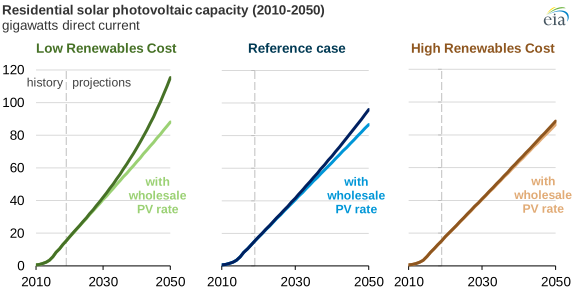 Figure 10.1: EIA retail-vs-wholesale compensation comparison (AEO2020). Public-domain-gov.
10.3 Safety and interconnection
A grid-tied inverter must include anti-islanding (Chapter 6.4): if the grid de-energizes, the inverter disconnects so it can’t energize a downed line and endanger line workers. Connecting legally requires a utility interconnection agreement and final Permission to Operate (PTO) (Chapter 40).
One-line diagrams, listed equipment, and required disconnects/labeling are all part of the approval.
10.4 Tradeoffs
Cheapest and simplest, with the best energy payback. A pure grid-tied system, however, provides no power during a grid outage (anti-islanding shuts it down even in daylight). Customers who want resilience need the architectures in Chapters 11–12.
10.4 Grid-tied one-line
 [ARRAY]──DC──[DC disc]──[INVERTER]──AC──[AC disc]──[MAIN PANEL]──[METER]──[GRID]
                          UL 1741/                    705.12 120%            net meter:
                          IEEE 1547                   busbar rule           export credits
                          (anti-islanding)

   No battery → grid absorbs surplus by day, supplies load at night.
   Grid fails → inverter shuts down (anti-islanding). NO backup.
Chapter 10 summary
Grid-tied systems use the grid as storage: simplest, cheapest, most efficient, but no outage backup. Economics hinge on net metering vs net billing export rules (verify locally). Grid connection mandates anti-islanding, an interconnection agreement, and PTO.
- Grid-tied (grid-direct): a PV system connected directly to the utility grid, with no battery; the grid absorbs surplus and supplies shortfalls.
- Net metering: a billing arrangement where exported energy offsets imports at (near) the full retail rate.
- Net billing (avoided-cost): a billing arrangement where exported energy is credited at a lower, wholesale-ish rate; makes self-consumption more valuable than net metering.
- Anti-islanding: the inverter’s required safety function that disconnects from the grid when utility power fails, preventing backfeed onto downed lines.
- Interconnection agreement: the utility contract that authorizes a PV system to operate in parallel with the grid.
- PTO (Permission to Operate): the utility’s written sign-off that the system may begin exporting energy.
Full definitions: Appendix A (glossary).
Practice Problems: Chapter 10
- In a grid-tied system, what plays the role of “storage”?
- Why does a standard grid-tied system go dark during a grid outage?
- What’s the difference between net metering and net billing for the customer’s economics?
- Name the three grid-connection requirements every grid-tied system must satisfy.
Solutions: Chapter 10
- The grid itself: surplus is exported by day, energy drawn back at night.
- Anti-islanding shuts the inverter down to protect line workers; without a battery/island-capable inverter there’s no backup.
- Net metering credits exports at (near) the retail rate; net billing credits them at a lower export rate, reducing the value of exported energy and lengthening payback.
- Anti-islanding (UL 1741/IEEE 1547), an interconnection agreement, and PTO.