28. Electrical Safety
Learning objectives
- Explain why PV electrical hazards differ from ordinary wiring.
- Apply NFPA 70E safe-work practices and lockout/tagout with the PV caveat.
- Maintain energized-work discipline on DC.
28.1 The hazard you can’t switch off
Ordinary electrical work begins by de-energizing the circuit. A PV array can’t be switched off: it’s energized whenever light hits it. That single fact reframes everything: source-circuit conductors are live during installation and service, and DC arcs don’t self-extinguish the way AC arcs do, making arc-flash and arc-blast especially dangerous on the DC side.
28.2 NFPA 70E and approach boundaries
NFPA 70E (Standard for Electrical Safety in the Workplace) defines safe-work practices for shock, electrocution, arc flash, and arc blast. Developed at OSHA’s request, it underpins compliance with OSHA 1910 Subpart S and 1926 Subpart K. Its key concepts are the arc-flash boundary, the shock-approach boundaries, and arc-rated PPE matched to the incident energy when work inside those boundaries is unavoidable. Note: DC arc-flash modeling for PV is still developing; treat DC incident-energy values as conservative pending finalized methods.
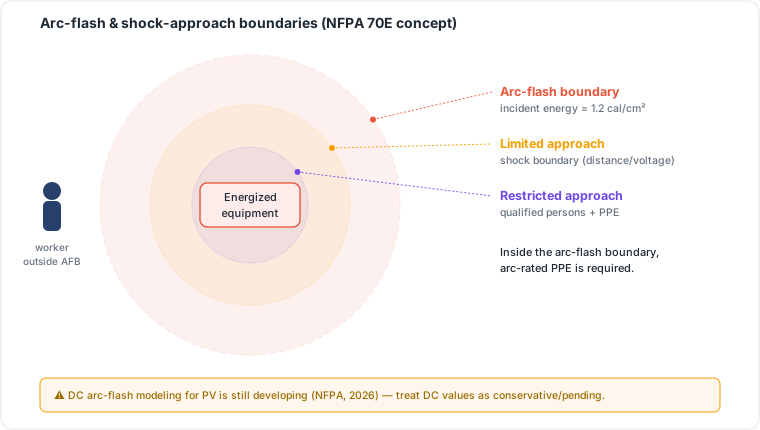 Figure 28.1: Arc-flash and shock-approach boundaries (NFPA 70E concept). DC arc-flash modeling for PV is still developing, treat DC values as conservative. Original figure.
28.3 Lockout/tagout and the PV exception
LOTO (29 CFR 1910.147) controls hazardous energy by de-energizing and locking out sources before work. The PV caveat is critical: you can lock out the AC side and the disconnects, but the modules themselves remain live in daylight. Covering modules or working at dawn/dusk is not a reliable de-energization method. ⚠️ Treat all DC PV conductors as energized at all times. Verify de-energization where possible, test before you touch, and never assume a “dead” array.
28.4 The “is it safe to touch?” flow
   Need to work on a PV circuit?
            │
            ▼
   Is it DC (array side)? ──YES──► Assume ENERGIZED whenever there is light.
            │                      Covering modules / dusk is NOT reliable.
            NO                     Use insulated tools + arc-rated PPE; TEST before touch.
            │
            ▼
   AC side: apply LOTO (1910.147) ──► verify de-energized with a meter ──► test-before-touch
            │
            ▼
   Inside an arc-flash / shock boundary (NFPA 70E)? ──► wear arc-rated PPE for the incident energy
⚠️ The golden rule: test before you touch, every time. A “dead” array in daylight is a contradiction in terms.
Chapter 28 summary
PV’s defining electrical hazard is that the array is always live in light and DC arcs don’t self-extinguish. Follow NFPA 70E boundaries and arc-rated PPE, and use LOTO on the AC side. Treat DC conductors as energized regardless, test before touching, and never rely on covering modules.
- Arc-flash boundary: the distance at which an unprotected worker could suffer a second-degree burn; work inside it requires arc-rated PPE.
- Arc-rated PPE: protective clothing and gear rated in cal/cm² to resist ignition from an arc-flash event.
- Incident energy: the thermal energy (cal/cm²) predicted at a working distance during an arc-flash; determines PPE arc-rating required.
- LOTO (Lockout/Tagout, 29 CFR 1910.147): OSHA procedure to de-energize and lock out hazardous energy sources before work begins.
- NFPA 70E: the electrical safety standard defining approach boundaries and PPE requirements for energized work.
- PV energized-work rule: DC source-circuit conductors must be treated as live whenever light is present; LOTO cannot make the array itself dead.
Full definitions: Appendix A (glossary).
Practice Problems: Chapter 28
- Why can’t you fully de-energize a PV array the way you’d de-energize an ordinary branch circuit?
- Why are DC arcs more dangerous than AC arcs?
- What standard defines arc-flash boundaries and arc-rated PPE requirements?
- LOTO can lock out which side of a PV system, and which side must still be treated as live?
- State the single most important habit before contacting any PV conductor.
Solutions: Chapter 28
- The modules generate voltage whenever light hits them. There’s no upstream switch that makes the array itself dead in daylight.
- DC arcs don’t self-extinguish (no zero-crossing), so they sustain and are harder to interrupt.
- NFPA 70E.
- LOTO controls the AC side and disconnects; the DC array side stays live in light.
- Test before you touch: verify with a meter; never assume.