21. The NEC and PV
Learning objectives
- Explain what the NEC is, its revision cycle, and the edition-adoption reality.
- Navigate the structure of Article 690 and its sibling articles.
- Identify the key sections an installer references constantly.
21.1 What the NEC is: Which Edition Applies
The National Electrical Code (NFPA 70) is the model electrical-safety code, revised on a three-year cycle. Critically, the NEC is not law until a jurisdiction adopts it, so different places enforce different editions simultaneously:
- NEC 2026 was issued August 20, 2025 and became effective September 9, 2025. As of March 1, 2026, no state had adopted it statewide (only scattered local jurisdictions had moved early); most jurisdictions still enforce NEC 2023, and some NEC 2020 or 2017.
- ⚠️ Always design to the edition your AHJ has adopted, plus local amendments. Around half of US PV is installed where the adopted code lags the latest edition by three years.
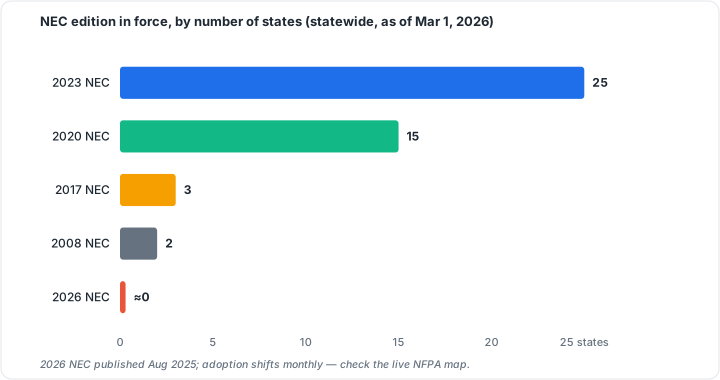 Figure 21.1: NEC edition in force by number of states (statewide, as of Mar 1, 2026). Adoption shifts monthly. Check the live NFPA map. Original figure.
21.2 The article map
PV touches several NEC articles:
- Article 690 (Solar Photovoltaic Systems): the primary article, organized into parts: General Requirements, Circuit Requirements, Disconnecting Means, Wiring Methods, Grounding and Bonding, Marking, and Connectors.
- Article 691 (Large-Scale PV): utility-scale supply stations.
- Article 705 (Interconnected Power Production Sources): how PV/storage connect to the grid and premises wiring (busbar rules, power control systems).
- Article 706 (Energy Storage Systems): batteries (first appeared in the 2017 NEC).
- Article 710 (Stand-Alone Systems) and Article 480 (Stationary Standby Batteries).
- Article 250 (Grounding and Bonding): the general grounding article that Article 690 Part V leans on.
- Note: as of the 2023 NEC, the per-article “.2” definitions were consolidated into Article 100.
21.3 The sections you’ll live in
Within Article 690, a working installer references a recurring set:
- 690.7: maximum voltage (the cold-Voc calculation, Ch 15).
- 690.8 / 690.9: maximum current, conductor sizing, and overcurrent protection (Ch 16).
- 690.11: DC arc-fault circuit protection (AFCI).
- 690.12: rapid shutdown (Ch 22).
- 690.13 / 690.15: disconnecting means.
- 690.31: wiring methods.
- 690.41–690.47: grounding and bonding (Ch 22).
- 690.56: marking/labeling. Plus 705.12 (busbar/interconnection) and 705.13 (power control systems).
21.4 Beyond the NEC
The NEC is necessary but not sufficient. The International Fire Code (IFC) governs rooftop access and setbacks (Ch 26); NFPA 855 governs storage installation (Ch 9/29); and OSHA 29 CFR 1910.303 requires listed equipment to be installed per the manufacturer’s instructions. A compliant job satisfies all of them, and the AHJ has final say.
21.5 Article 690 section map (quick navigation)
| Section | Governs | Primer chapter |
|---|---|---|
| 690.7 | Maximum voltage (cold-Voc) | Ch 15 |
| 690.8 | Maximum current & conductor sizing | Ch 16 |
| 690.9 | Overcurrent protection | Ch 16, 23 |
| 690.11 | DC arc-fault (AFCI) | Ch 23 |
| 690.12 | Rapid shutdown | Ch 22 |
| 690.13 / 690.15 | Disconnecting means | Ch 23 |
| 690.31 | Wiring methods | Ch 23 |
| 690.41–690.47 | Grounding & bonding | Ch 22 |
| 690.56 | Marking / labeling | Ch 23 |
| 705.12 | Interconnection (busbar) | Ch 16 |
Chapter 21 summary
The NEC (NFPA 70) revises every three years but applies only as adopted. Most jurisdictions trail the latest edition, so design to the local one. Article 690 is the PV core (voltage, current, OCPD, AFCI, rapid shutdown, disconnects, wiring, grounding, marking), with 705 (interconnection), 706 (storage), and 250 (grounding) alongside it. The IFC, NFPA 855, and OSHA add requirements the NEC doesn’t.
- NEC (National Electrical Code / NFPA 70): the model electrical-safety code, revised every three years; applies only as adopted by a jurisdiction.
- AHJ (Authority Having Jurisdiction): the official with authority to enforce and interpret the adopted code edition.
- Article 690: the primary NEC article governing solar PV systems.
- Article 705: covers interconnection of PV and other power production sources to the grid or premises wiring.
- Article 706: governs energy storage systems (batteries).
- AFCI (Arc-Fault Circuit Interrupter): detects arc signatures and opens the circuit; required for PV by 690.11.
- OCPD (Overcurrent Protection Device): fuse or breaker that interrupts excessive current; sized per 690.8/690.9.
- Busbar: common connection bar inside a panel; capacity limits set by 705.12.
Full definitions: Appendix A (glossary).
Practice Problems: Chapter 21
- The latest NEC edition just published, but your county still enforces a three-year-old edition. Which one governs your plan set?
- Which NEC article covers (a) PV systems, (b) interconnection to the grid, (c) energy storage?
- A colleague cites “690.12.” Without looking it up, what topic are they discussing?
- Beyond the NEC, name two other code/standard families that impose requirements on a rooftop PV job.
- Why can two installers in neighboring towns be held to different label requirements for identical systems?
Solutions: Chapter 21
- The edition your AHJ has adopted (the older one), plus any local amendments, not the newest published edition.
- (a) Article 690, (b) Article 705, (c) Article 706.
- Rapid shutdown.
- Any two of: IFC (fire/access), NFPA 855 (storage), OSHA (worker safety), IBC/ASCE 7 (structural), UL (listings).
- Their towns may have adopted different NEC editions (or local amendments), and label rules change between editions.