5. PV Modules
Learning objectives
- Describe how a module is physically constructed and why each layer matters.
- Distinguish the dominant cell technologies (PERC, TOPCon, HJT, thin-film) by efficiency, temperature behavior, and degradation.
- Read every block of a module datasheet, not just the wattage.
- Explain module degradation modes and how warranties address them.
- Identify the safety and performance listings a compliant module carries.
5.1 Module construction
A crystalline-silicon module is a laminated sandwich engineered to protect fragile cells for 25–30+ years outdoors:
- Front glass: tempered, low-iron, anti-reflective; the structural and optical face.
- Encapsulant: typically EVA or POE film that bonds the layers and seals out moisture.
- Cells: the silicon wafers, interconnected by ribbons.
- Backsheet or rear glass: a polymer backsheet on traditional modules, or a second glass pane on glass-glass modules (more durable, required for most bifacial designs).
- Frame: anodized aluminum providing rigidity and a grounding/clamping surface.
- Junction box: houses the output leads and bypass diodes, which route current around a shaded or failed cell-group so one bad cell doesn’t choke the whole string (and prevents destructive hot-spots).
5.2 Cell technology: the state of the art
The market is mid-transition from p-type to n-type silicon, and the practical upshot for an installer is that the datasheet numbers you design around have shifted:
- PERC (Passivated Emitter and Rear Cell): the p-type workhorse that dominated the late 2010s. ~20–21.5% module efficiency, temperature coefficient around −0.35%/°C, annual degradation ~0.5%/yr. Now the budget option; its market share collapsed from over 80% of shipments in 2022 to under a quarter by 2026.
- TOPCon (Tunnel Oxide Passivated Contact): the current mainstream n-type technology, having overtaken PERC in under three years to reach roughly 70–80% of global cell production (2025). ~22–24% efficiency, temperature coefficient near −0.30%/°C, lower degradation (~0.4%/yr), and strong bifacial response. It is the safe default for most 2026 installs at a modest cost premium.
- HJT (Heterojunction): premium n-type combining crystalline and thin amorphous silicon. It delivers the highest mass-production efficiency (24–26% module class), the best temperature coefficient (~−0.25%/°C), and the lowest degradation (~0.25–0.30%/yr). It is moisture-sensitive and costlier, making it a specialist choice for high-heat, high-albedo, or tight-roof sites.
- Thin-film (CdTe especially): lower efficiency per area but excellent temperature and low-light behavior and a major utility-scale presence; not common on residential roofs.
⚠️ Why this matters to you, not just the factory: a lower (better) temperature coefficient means less voltage swing across the seasons, which changes string sizing (Chapter 15). Higher efficiency means more watts in the same roof area. Don’t choose on price-per-watt alone. Choose on site-specific energy yield and how the module’s voltage behavior fits your inverter.
Across the market, the average commercial c-Si module now runs about 22.7% (Fraunhofer, Q4 2024), with TOPCon the dominant production technology.
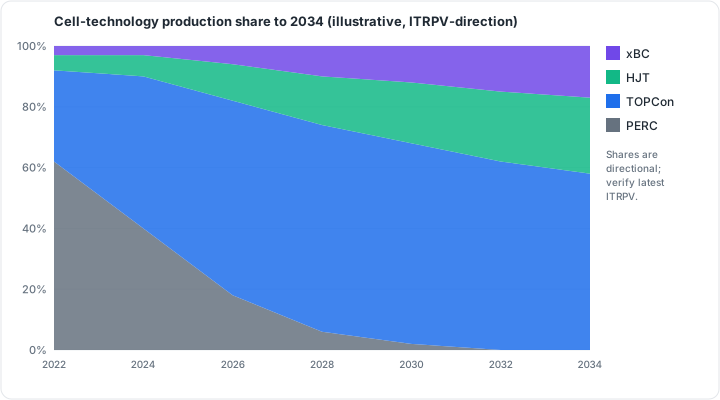 Figure 5.1: Cell-technology production share to 2034 (illustrative, ITRPV-direction). Original figure.
5.3 Bifacial modules
Bifacial modules generate from both faces, harvesting light reflected off the surface below (ground, white roof, gravel). Real-world gains run from a few percent on dark rooftops to low-double-digits over high-albedo ground mounts. They’re glass-glass, pair naturally with TOPCon/HJT, and complicate sizing slightly because rear-side gain raises current. Account for it in conductor and inverter sizing.
5.4 Reading the datasheet (the whole thing)
Beyond the Part I five (Pmax, Voc, Isc, Vmp, Imp at STC), a module datasheet gives you:
- Temperature coefficients (β for Voc, γ for Pmax, α for Isc): for the cold/hot calculations of Chapter 15.
- NOCT / NMOT: nominal operating cell temperature, the basis for more realistic output estimates than STC.
- Maximum system voltage (commonly 1,000 or 1,500 V): the ceiling your cold-Voc string total must stay under.
- Maximum series fuse rating: sets source-circuit overcurrent protection (Chapter 8/23).
- Mechanical load ratings: maximum snow (front) and wind (back) load in Pa; must exceed site structural demand (Part VI).
- Dimensions, weight, cell count: for layout and structural dead-load.
5.5 Degradation and warranties
Modules lose output over time through several mechanisms: an initial LID drop in the first hours/days, then slow annual decline; PID from voltage stress and humidity; and LeTID in some cell types. Two warranties accompany a quality module:
- Product warranty: workmanship/defects, typically 12–25 years.
- Performance warranty: guarantees the module still produces a stated percentage of nameplate at year 25/30 (n-type modules now warranty higher end-of-life output thanks to lower degradation).
5.6 Listings and standards
A code-compliant module in North America is listed to UL 61730, the harmonized PV-module safety standard. Since December 2019, UL 61730 applies to new products in place of the older UL 1703; UL 1703-listed products remain permitted until that standard is withdrawn. Internationally, the equivalents are IEC 61730 (safety) and IEC 61215 (performance/durability). These listings are what an AHJ and the NEC’s product-listing requirements expect to see.
5.7 Module cross-section
  ═══════════════════  tempered low-iron glass (front)
  ░░░░░░░░░░░░░░░░░░░  encapsulant (EVA/POE)
  ▓▓▓ cells + ribbons ▓▓▓  ◄ series-wired silicon cells
  ░░░░░░░░░░░░░░░░░░░  encapsulant
  ───────────────────  backsheet (or 2nd glass = glass-glass/bifacial)
  └─[ junction box: bypass diodes + leads ]─┘
  □ aluminum frame around the perimeter (bonding/clamping surface)
Bypass diodes in the J-box route current around a shaded/failed cell-group, preventing hot spots and limiting a shaded module’s drag on its string (Ch 18).
Chapter 5 summary
A module is a laminated, framed assembly with bypass diodes protecting series-wired cells. The industry has shifted from PERC to n-type TOPCon (now mainstream), with HJT as the premium and thin-film holding utility niches; technology choice changes efficiency, temperature coefficient, and degradation, all of which feed your design. Read the entire datasheet, especially temperature coefficients, max system voltage, and series-fuse rating. Compliant modules carry UL 61730 / IEC 61730 + IEC 61215 listings.
- PERC: p-type cell technology; the former mainstream, now the budget option (~20–21.5% efficiency).
- TOPCon: n-type mainstream cell technology as of 2025–26; better efficiency, lower degradation, and stronger bifacial response than PERC.
- HJT (Heterojunction): premium n-type cell; highest efficiency and lowest temperature coefficient in mass production.
- Bifacial: a module design that generates from both front and rear faces by capturing reflected light.
- Encapsulant: polymer film (EVA/POE) that bonds and seals the cell stack inside the module.
- Bypass diode: a diode in the junction box that routes current around a shaded or failed cell-group, preventing hot spots.
- LID (Light-Induced Degradation): one-time output drop in the first hours of sunlight exposure.
- PID (Potential-Induced Degradation): ongoing output loss from voltage stress and humidity leakage.
- NOCT/NMOT: nominal operating cell/module temperature; a more realistic thermal baseline than STC.
- UL 61730 / IEC 61730: the harmonized safety listing required for code-compliant modules.
- IEC 61215: the performance and durability standard required alongside UL/IEC 61730.
Full definitions: Appendix A (glossary).
Practice Problems: Chapter 5
- What is the function of a module’s bypass diodes?
- What distinguishes a glass-glass module, and which feature does it enable?
- Which cell technology is the 2026 mainstream, and which is the premium high-efficiency option?
- Name the two listings a code-compliant module carries (safety + performance).
- Why does a frame matter electrically, not just structurally?
Solutions: Chapter 5
- They route current around a shaded or failed cell-group, preventing destructive hot spots and limiting string drag.
- A second glass pane replaces the backsheet (more durable); it enables bifacial generation.
- Mainstream: TOPCon; premium: HJT.
- UL 61730 (safety) and IEC 61215 (performance/durability); internationally, UL/IEC 61730 + 61215.
- The aluminum frame is part of the equipment-bonding/grounding path (with UL 2703 hardware, Ch 22).